
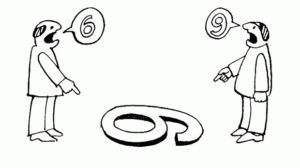
With a good vantage point, it can be pretty easy to see what’s going on.
Regardless of what you think of the term, regardless of what you think of Dr. Richard Gardner and his work, regardless of your experiences, if you are reading this, you know what parental alienation means, and the term is therefore useful in that regards.
Since 2005, Canadian Co-Parenting Centres has been involved in helping families where parental alienation has been alleged and denied. While we have generally been more aggressive and innovative than others, we have been mired in a professional culture that has been woefully unable to adequately address the issue, and regrettably we have not grown large enough to be a significant force for change, and we have not spoken out boldly enough. With this webpage, we are changing the latter.
In short, if you feel that your relationship with your children is strained or severed due to parental alienation, then look no further, you have found the resource that you need.
If you are being accused of inculcating parental alienation and are seeking to be exonerated, then look no further, you have found the resource that you need.
If you ARE inculcating parental alienation, or if you ARE a poor parent, or difficult person, that your children rightly want to have very little to do with, then having us involved will expose that. The bind is, if you resist the other parent’s efforts to have us involved, that in itself is a litmus test, which will expose you.
Ultimately, our involvement will BENEFIT you, but you won’t recognize that at this point, so we won’t elaborate here.
Let us repeat this, to make sure it is crystal clear. If you resist having a parenting coordination process put in place, it’s like an athlete or team not wanting a referee. If you resist putting in place a parenting coordination process with us, it is because you do not want your true character and behaviours to be discovered. Of course, it would be fine to hire some other parenting coordinator to do what we do, but if you are wanting to hire one that does not have the same level of checks and balances, commitment and determination, then there is only one plausible reason. You are cherry picking a referee that you think you can outmaneuver.
When we work with families, we involve two parenting coordinators. One is very attuned to picking up on things that parents do that strain their relationship with their children, and the other is very attuned to pick up on things that inculcate parental alienation.
Talk is cheap. Actions speak louder than words. These expressions are well known for a reason. The rejected parent will be challenged to demonstrate their commitment, and their desire. For example, after a successful 20 minute supervised visit at a Booster Juice, following an 18 month long break in contact, one parent was asked to meet with their daughter every day during her school lunch break. The parent would have to arrange for some extra time away from work, drive across town and then back, to spend about 10 minutes with their child.
In this case, the rejected parent was immediately willing to do this, and the aligned parent immediately tried to prevent it from happening, claiming all sorts of reasons, and then wanting to fire the parenting coordinator, mere weeks into the process. Perhaps not definitive evidence, but pretty compelling none the less.
We will generally suggest that the children reside for a 2 or 3 week period with someone that is neutral. This gets the children out of a loyalty bind, either a perceived one, or a real one. A supportive parent will readily agree to this, and will utilize the break from primary care to get caught up on all sorts of things. An alienating parent will resist this. Again, perhaps not definitive evidence, but pretty compelling none the less.
In order to effectively assist a family we need to ascertain approximately where they are situated on the grid of treatment plans below.
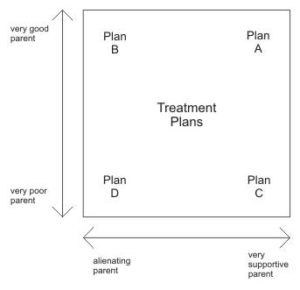
To some degree, it can be difficult to ascertain, but little tests like were described above will readily identify the shade of treatment plans that is most likely required.
A favoured parent’s efforts to pressure the child(ren) to have a relationship with the other parent MAY be an indication of a supportive parent, but not necessarily so. Pressure from an alienating parent can trigger an increased resistance in the child(ren) to withdraw from and reject a parent.
Later in this page we will assert that people ultimately know what is going on, and while that is true, to an amazing degree people can convince themselves of an inaccurate reality, which they believe very thoroughly. This can be observed in a great many situations, but invariably, these people that seem to be oblivious to something, are impulsively defensive in reaction to any exploration of that which appears to be unknown.
Costs are often used manipulatively. An alienating parent will claim that they can’t afford the services, and a poor parent will bemoan their circumstances. Unlike private practice professionals, we structure things so that our services are much more affordable, and it will only be expensive if you are alienating or if you are creating justified rejection.
Currently, our work is undermined by several things. It’s better than it was for many years, but there are still big impediments.
The court system should readily insist on putting a parenting coordination process in place.
Legal Aid needs to curtail misuse of their services.
While it is true that children will “vote with their feet”, and we collectively can’t force alienated children to be with a rejected parent, and that may well not be healthy for a child, the court system should readily grant an Emergency Protection Order when alienation is suspected, thus ensuring that children are not exposed to a harmful environment. As a society, we undertake to protect children from harmful environments as a regular practice. There is no reason to continue to neglect and avoid parental alienation. The children can be placed with a neutral person and there can be a restraining order between the children and the potentially alienating parent. As described above, a temporary disconnect between the children and a potentially alienating parent can be very enlightening.
To avoid misuse of Emergency Protection Orders, which has been going on for decades, and long before the 1985 introduction of the term Parental Alienation Syndrome, courts need to impose significant consequences for applications made using misleading and false information. If the court continues to allow people to lie in family court with impunity, problems will persist and children will ultimately suffer.
Children’s Services need to be willing to support parenting coordinators that identify a potential alienation situation. While it is not the role of a parenting coordinator to do a formal diagnosis of parental alienation, they are uniquely positioned to be able to detect indicators. (Akin to smoke detectors.)
People that are not doing anything wrong, and are seeking to be exonerated, will welcome a thorough assessment. People that have something to hide will resist. Ultimately, both parents pretty much know what is actually going on, despite the fact that they present otherwise. Assessments are generally expensive, and if the person that is misrepresenting things is at risk of incurring the entire cost, they will generally balk. This, again, is a useful litmus test. If adequately pressed to anti up, they will fold.
In most situations, BOTH parents are doing things that they shouldn’t. Saying negative things, involving the children in matters that don’t relate to them, and doing things that potentially undermine the children’s relationship with the other parent. While we certainly don’t condone such behaviours of rejected parents, we understand the context. We implore them to stop doing this, and we convey to them that it is making their situation worse. That said, when doing an assessment, there is a difference.
If someone fails to stop at a stop sign, the consequence in Alberta is a $388 fine and 3 demerits on their license. If someone fails to stop at a stop sign, and it just happens to be at the same time a bus full of Junior hockey players is going through the intersection, the consequence is 8 years in jail. Capeesh?
Generally speaking, the parent that is misrepresenting things will try to have the parenting coordinator removed, claiming bias, not qualified, etc. They will also stop paying for the services being provided. Most professionals will insist that the other parent pay, or the professional will quit. We will do neither. We will never abandon a family, and their children, and we will never impose costs onto a parent that is doing their best.
The key that has been missing is a way to impose a financial consequence. We conceived of a strategy to have parenting coordination be a Section 7 expense, so that MEP can be utilized. If the amount of child support that an alienating parent is getting decreases by a few hundred dollars, their behaviour will change. They will discover that their gig is up. The barking dog CAN bite.
We know of one other parenting coordinator that has adopted a similar Section 7 expense strategy, and his primary profession is a that of a senior family law lawyer. To our knowledge, no one has tested the process to confirm that MEP and the Courts will do their part. We have tried to test it, and either get it confirmed, or discover what needs to be adjusted, but none of the attempts have proceed that far.
These and other consequences should be the norm, and they should be widely understood by everyone.
Things like 3 for 1 make up time being a standard will also curtail the gate keeping and interference that is part of alienation.
The medical health profession and the legal community has been trying to address parental alienation without directly confronting the conduct of the alienating parent. Like a deer in the headlights, they do little or nothing, as they earnestly try to determine with certainty what is going on. Instead of considering a temporary separation, and recognizing the value of it, they’ve been distracted by the idea of switching “custody”, fearful of making a mistake.
No one would recommend giving a person oxygen treatments for one hour once a week as a therapy for people that are living in a basement with high levels of Radon gas.